What Is Warehouse Labor Intelligence?
Learn what warehouse labor intelligence is, how it differs from a traditional LMS or WMS, and why real-time labor visibility matters for throughput, cost, and service.
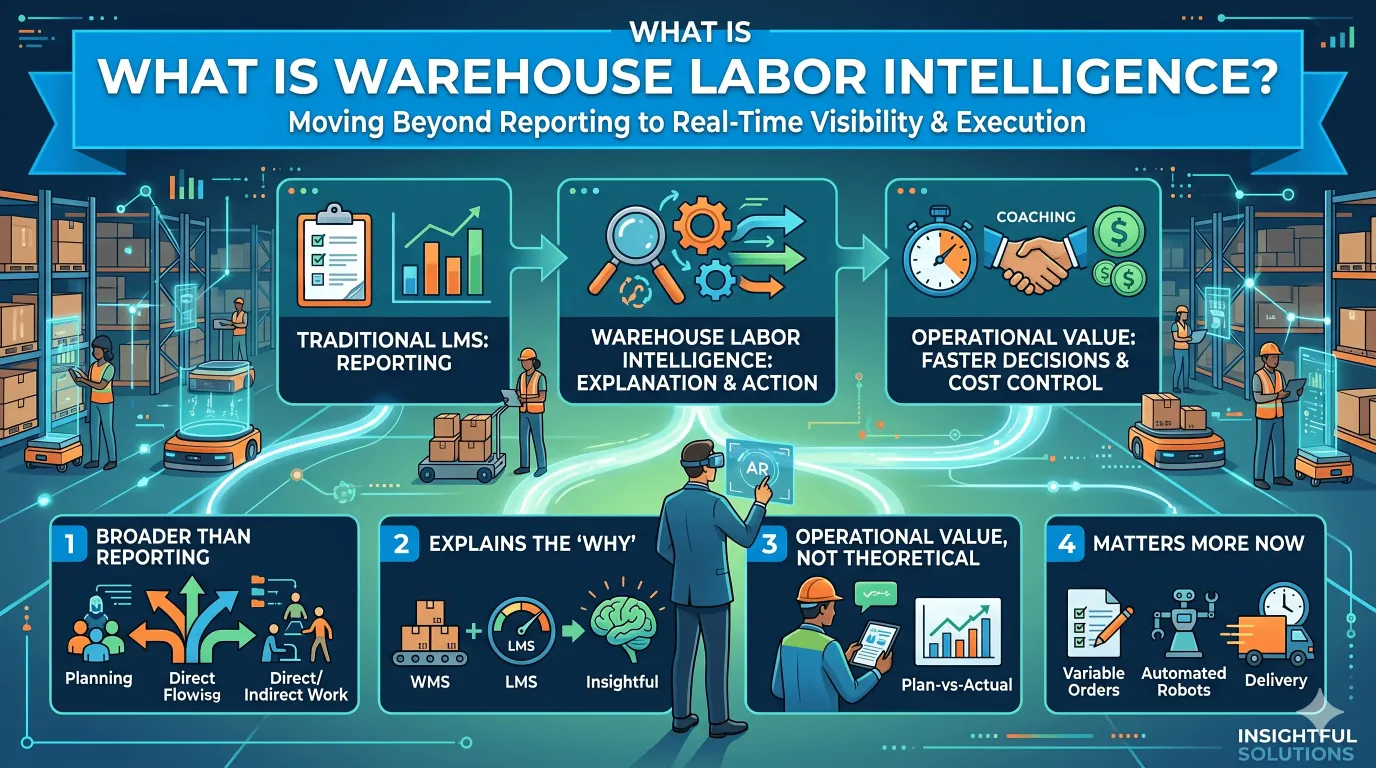
Key Takeaways
Warehouse labor intelligence is broader than labor reporting. It combines planning, direct and indirect work, performance, and live execution context.
A WMS shows transactions. A traditional LMS shows performance against standards. Labor intelligence helps explain what is happening across the shift and what leaders should do next.
The value is operational, not theoretical. Better labor intelligence supports faster in-shift decisions, fairer coaching, cleaner plan-versus-actual management, and tighter cost control.
It matters more now because warehouse operations are more variable, more automated, and more service-sensitive than they were even a few years ago.
Labor reporting is part of labor intelligence, but it is not the whole thing.
A historical report can tell you what happened yesterday. It may show units per hour, earned hours, department productivity, or utilization by shift. That is useful for review. It is much less useful when a supervisor is trying to answer a live question like:
Which zone is starting to drift?
Is the issue labor availability, replenishment, congestion, or indirect work?
Are we still executing against the labor plan?
Which move would protect throughput in the next hour?
Warehouse labor intelligence should make those questions easier to answer.
What warehouse labor intelligence includes
A strong warehouse labor intelligence model usually brings together five things.
1. Labor planning context
What did the operation expect to happen?
That includes volume assumptions, staffing plans, expected work content, and labor allocation by function or area. Without the planning baseline, teams can see performance but struggle to see drift.
Takt’s labor planning solution is relevant here because planning only becomes useful when it stays connected to the shift as it unfolds.
2. Direct and indirect labor visibility
How was the paid day actually used?
Teams need visibility into direct productive work, but also into meetings, training, staging, quality checks, value-added services, waiting, troubleshooting, and support work. This is especially important in 3PL and high-variability environments where indirect activity materially changes labor cost and execution capacity.
Takt’s indirect labor solution shows why this matters: indirect labor is often operationally necessary, but it becomes expensive when it is invisible.
3. Performance versus expected work
How did actual labor use compare with the standard or target?
This is where utilization, earned hours, and standard adherence become useful. It is also where operations teams can separate a real performance issue from a planning problem or workflow-design problem.
4. Real-time operating context
What is happening now that may change the result of the shift?
That may include congestion, queue buildup, replenishment delays, automation handoff issues, workload spikes, or service risk building in one part of the building before it becomes obvious elsewhere.
5. Actionability
Can a supervisor, CI leader, or site manager do something with the signal?
If the answer is no, the system may still be analytics, but it is not yet strong labor intelligence. The best labor intelligence is usable in the moment.
Why a WMS and a traditional LMS are not enough by themselves
A WMS is foundational. It manages inventory and task flow. A traditional LMS is also valuable. It measures labor performance against standards and helps with coaching and accountability.
But neither system, by itself, is designed to tell the full operating story.
A WMS can tell you that a task happened. It may even tell you who did it and when. A traditional LMS can tell you whether labor performance met the expected standard. What they often do not explain well is everything that happened between the transactions or around them:
work that was delayed before it started
support work that consumed labor quietly
congestion between zones
automation that shifted the real constraint downstream
a labor plan that stopped matching reality two hours into the shift
That is where warehouse labor intelligence becomes useful.
What changes when labor intelligence is working
When labor intelligence is strong, warehouses stop relying on partial stories.
Supervisors can coach with more context. CI teams can see whether a miss came from poor execution, poor work design, or poor planning. Executives get a clearer link between labor performance and business outcomes like throughput, service, cost per unit, and margin.
More specifically, labor intelligence helps teams:
compare shifts and zones more fairly
isolate indirect work that is distorting performance
recover hours that would otherwise disappear into delay or drift
spot service risk earlier in the shift
connect labor decisions to cost and throughput, not just to output metrics
Why the category matters now
Warehouse operations are getting harder to manage with siloed systems.
Facilities are dealing with more mixed workflows, tighter customer commitments, more automation, more network complexity, and greater pressure to control labor without losing flexibility. In that environment, after-the-fact reporting is too late.
Operations leaders need a way to connect labor, demand, execution, and support work while the work is still happening. That is why the market keeps moving toward orchestration, live decision support, and broader operational visibility.
Where Takt fits
Takt’s category story is strongest when warehouse labor intelligence is defined in practical terms.
Takt connects labor planning, floor activity, indirect work, and real-time performance so warehouse teams can understand what is happening during the shift and where to act next. That makes labor more than a backward-looking KPI. It turns labor into an active operating lever.
Takt also ties naturally into adjacent guide topics such as how to measure ROI for warehouse labor management and warehouse continuous improvement, because better labor intelligence improves both financial visibility and daily improvement discipline.
FAQ
What is warehouse labor intelligence?
Warehouse labor intelligence is the ability to combine labor planning, direct and indirect work, real-time operating signals, and performance context into one view that helps leaders make better in-shift decisions.
How is warehouse labor intelligence different from a labor management system?
A labor management system usually focuses on standards, productivity, and performance measurement. Warehouse labor intelligence is broader. It adds planning context, indirect work visibility, live operational signals, and actionability.
Why does warehouse labor intelligence matter?
It matters because many labor problems are not visible in task-level data alone. Teams need to understand where paid time is going, where drift is building, and which decisions will improve throughput, service, and cost before the shift is over.
Who benefits most from warehouse labor intelligence?
Warehouse leaders, supervisors, CI teams, 3PL operators, and executive buyers all benefit when labor data becomes clearer, faster, and easier to act on.
Final thought
Warehouse labor intelligence is not just a new label for labor software.
At its best, it is a better way to run the building. It turns fragmented labor and execution data into a live operating model that helps teams protect throughput, control labor, and make better decisions before performance slips.
Related on Takt: Labor Management System and Labor Analytics.